



In a precarious and tense situation, England found itself facing a substantial deficit against DR Congo during the initial half of Wednesday’s intense and highly anticipated World Cup round of 32 match. The atmosphere was charged with excitement and anxiety as the teams battled fiercely on the field. Harry Kane, the England captain and a key player, appeared to have skillfully secured a penalty for his team. This pivotal opportunity could have enabled the Three Lions to equalize the score and regain crucial momentum in the game, potentially shifting the tide in their favor.

The England captain struck the ball past the Congolese goalkeeper, Lionel Mpasi-Nzau, with precision and power. However, after making contact with the goalkeeper’s legs, Kane collapsed to the ground dramatically. The referee, Adham Makhadmeh, blew his whistle, but instead of indicating the penalty spot, he signaled a free kick for DR Congo, leaving both players and fans in shock and disbelief. Kane managed to evade a yellow card for an apparent dive, but he expressed his anger and frustration, insisting vehemently that he had been brought down by Mpasi-Nzau.
A VAR review was conducted to reassess the situation, but to the dismay of England fans, no penalty was awarded. The decision sparked widespread dissatisfaction among the supporters, who voiced their discontent loudly and clearly. Concurrently, heavily partisan analysts for BBC Sport in the United Kingdom were perplexed and could not comprehend why a penalty was not given despite the clear contact between Kane and the goalkeeper. “They have made a grave error,” ex-England No. 1 Paul Robinson exclaimed passionately, echoing the sentiments of many.
Alan Shearer, who captained England during the 1998 World Cup, asserted that Kane had “every right” to initiate that contact and fall to the ground. “There is contact, and there is no doubt. In my opinion, that constitutes a penalty,” Shearer declared confidently, providing a strong argument in favor of Kane’s claim. The decision not to award a penalty left a lingering sense of injustice and frustration among England fans and analysts alike, as the match continued with the Three Lions trailing behind.

Kane ‘Jumps into the Goalkeeper’
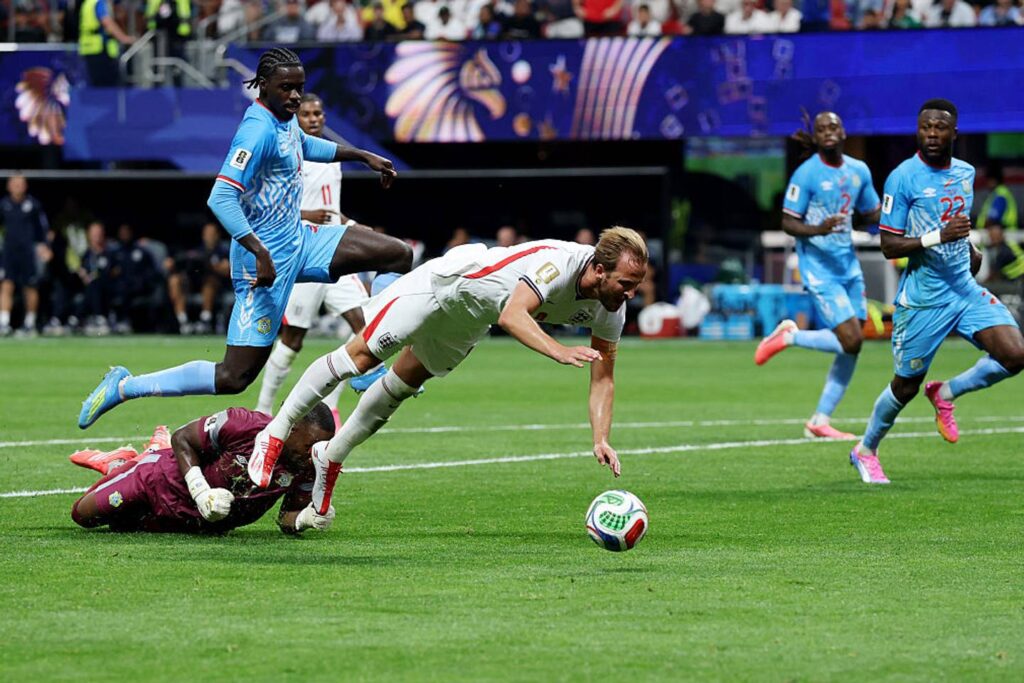
The incident involving Harry Kane and goalkeeper Mpasi-Nzau during the match is a complex situation that requires a detailed analysis to fully understand the dynamics at play. While it is evident that Mpasi-Nzau made contact with Kane, leading to his fall, the circumstances surrounding the incident are multifaceted and warrant a closer examination.
Kane was exhibiting significant forward momentum at the time of the incident, which played a crucial role in his rapid descent before the goalkeeper’s approach. This forward momentum, combined with the nature of the contact, raises questions about the intent and implications of the interaction. The angle at which Kane approached Mpasi-Nzau, the speed of both players, and the physicality involved are all critical factors that need to be considered to gain a comprehensive understanding of the situation.
Initially, Kane’s right toe caught the turf, causing him to stumble. In that split second, he may have realized that the ball was slipping away from him. Seeing Mpasi-Nzau approaching, Kane might have strategically positioned his legs to ensure that the goalkeeper would make contact, leading to a perceived foul. This strategic positioning suggests a level of awareness and intent on Kane’s part, which adds another layer to the incident.
By the time Mpasi-Nzau reached Kane, the England captain was already arching his back, a move that seemed designed to maintain his position and ensure that he would be fouled. This action indicates that Kane was anticipating the contact and positioning himself to maximize the likelihood of being awarded a foul. The goalkeeper, Mpasi-Nzau, appeared to pull his hands into his body as he approached, which could have minimized the impact of the contact. However, Kane’s positioning ensured that the contact was significant enough to be noticed.
Wayne Rooney, Kane’s predecessor as England captain and the country’s all-time leading goalscorer, offered his perspective on the incident while working on the U.K.’s BBC broadcast. Rooney was not convinced by Kane’s actions, stating, “He trips himself and jumps into the goalkeeper.” This viewpoint highlights the subjective nature of the incident and the differing interpretations of what transpired.
The decision by the referees not to refer the incident to VAR can be understood in the context of the tournament’s high bar and precedent for interventions. Very few decisions have been overturned in cases of minimal contact, as the on-field decision is not considered a “clear and obvious error.” This approach reflects a broader trend in the tournament, where referees have been cautious about making VAR interventions unless there is undeniable evidence of a mistake.
In contrast, there has been a notable change in the awarding of free-kicks for goalkeepers who are bumped or put under duress at set pieces. This shift was evident when Germany’s Jonathan Tah had a goal disallowed, a decision that contributed to Germany’s elimination from the tournament by Paraguay. This change underscores the evolving nature of officiating standards and the emphasis on protecting goalkeepers during set pieces.
Overall, the incident between Kane and Mpasi-Nzau is a complex interplay of strategic positioning, momentum, and officiating standards. It highlights the challenges faced by referees in making split-second decisions and the varying interpretations of player actions. As the tournament progresses, such incidents will continue to spark debate and analysis, contributing to the ongoing evolution of the game.